Volcanoes as a resource, today and yesterday
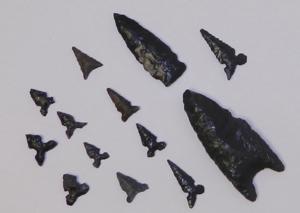
Obsidian points come in a variety of sizes, and can be finely crafted despite the brittle nature of obsidian. Photo courtesy of Imperial Valley Desert Museum
Posted: Saturday, October 18, 2014
By NEAL V. HITCH Special to this Newspaper/Imperial Valley |
If we think of volcanoes as a resource today, we might think of geothermal energy. But for thousands of years volcanoes were a resource for tool making.
Volcanic rocks, or igneous rocks created when magma erupts, are the most common rocks on Earth. Rhyolite is a light-colored, volcanic rock that encompasses many kinds of rocks, such as pumice, obsidian, and wonder stone. The volcano at Obsidian Butte near what is now the Salton Sea last erupted in 940 BCE creating valuable resources for Native Americans. Areas around Ancient Lake Cahuilla were known as important sources of rhyolite and were actively quarried.
Rhyolite is formed as lava flows and cools. Different kinds of minerals in the magma create different kinds of rhyolite. Two types that were used extensively for making tools in the Imperial Valley are obsidian and wonder stone. High in silica, when fractured, they create a sharp edge that is perfect for knives and projectile points. It is only thanks to volcanic eruptions, which we normally think of as a destructive force, that these tools could be created.
The science of obsidian
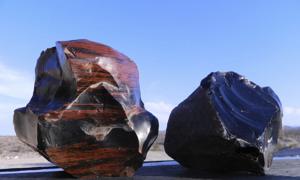
Obsidian is one of the most recognizable of all the rhyolitic rocks. It is a naturally occurring volcanic glass, or lava that cools faster than minerals can crystallize. Because it is not made of mineral crystals, obsidian is technically not a rock at all, but a congealed liquid made of at least 70 percent silica. It is the ice cube of the rock world!
Obsidian has no natural plane of separation. When broken, it breaks into a "conchoidal fracture," just like glass in a window. This creates an incredibly sharp edge, making obsidian a valued resource throughout human history.
Obsidian has been used for everything from knife blades and spear points to highly polished mirrors, and jewelry. The earliest known obsidian tools are nearly two million years old from a site in eastern Africa. Even today, obsidian scalpels are used by doctors in specialized surgeries.
In an archaeological context, obsidian is also important. Every volcano has a unique combination of trace elements, making it possible for archaeologists to trace the origins of an obsidian artifact's raw material — no matter where it is found in the world. Obsidian was highly valued as a trade item and can be tracked hundreds of miles from its original source location along trade routes.
Obsidian hydration dating
Over time, obsidian absorbs water and can be dated in a scientific process known as obsidian hydration dating. The water absorption occurs at the surface and creates a narrow rind. A small slice cut out of the artifact and placed under a high-powered microscope allows a scientist to measure the rind and determine a date range for the artifact. The idea is simple: the longer the artifact has been exposed to the air, the thicker the hydration rind.
Today, hydration dating is used extensively by archaeologists to date obsidian artifacts at prehistoric sites both in California and around the world. Though highly useful, the technique is not perfect. Artifacts exposed to higher temperatures or lower elevations hydrate at different rates. When the environment of the artifact is known, scientists can take these factors into account during dating. Therefore, it is extremely important to know where the artifact is from and the environment to which it was exposed.
Wondering about wonder stone
Wonder stone is a name for a finely grained, banded rhyolite. This type of rhyolite is hydrothermally altered so that minerals, like iron and manganese, form bands of colors in the rock. Wonder stone has 69 percent silica, less than obsidian, but still enough to allow for conchoidal fractures that make it nearly as sharp as obsidian.
The Imperial Valley contains a quarry of wonder stone (also called Rainbow Rock Quarry) near the Salton Sea. It is one of the largest and most intensively used quarries in the Colorado Desert. Excavated by Morlin Childers, Erlinda Burton, and a field class from IVC in 1992, this site proved to have an enormous number of cores, flakes, and tools suggesting it was a major quarry location in Southern California. The geologic signature of the stone found at this site allow archaeologists to track the distribution of Rainbow Rock Quarry stones across trade and travel routes.
Neal V. Hitch is director of the Imperial Valley Desert Museum.
--



__._,_.___


No comments:
Post a Comment