Iceland's volcanoes may power UK
The energy minister is to visit Iceland in May to discuss connecting the UK to its abundant geothermal energy
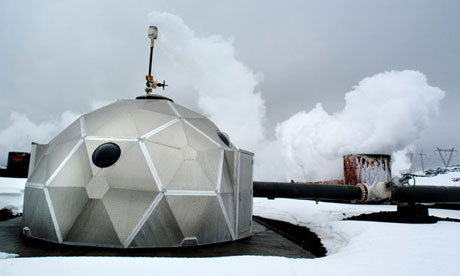
The volcanoes of Iceland could soon be pumping low-carbon electricity into the UK under government-backed plans for thousands of miles of high-voltage cables across the ocean floor.
The energy minister, Charles Hendry, is to visit Iceland in May to discuss connecting the UK to its abundant geothermal energy. "We are in active discussions with the Icelandic government and they are very keen," Hendry told the Guardian. To reach Iceland, which sits over a mid-ocean split in the earth's crust, the cable would have to be 1,000 to 1,500km long and by far the longest in the world.
Hendry has already met the head of Iceland's national grid about the plan. The web of sea-floor cables – called interconnectors – planned for the next decade would link the UK to a Europe-wide supergrid, which is backed by the prime minister. The supergrid would combine the wind and wave power of northern Europe with solar projects such as Desertec in southern Europe and north Africa to deliver reliable, clean energy to meet climate change targets and reduce dependence on fossil fuel imports.
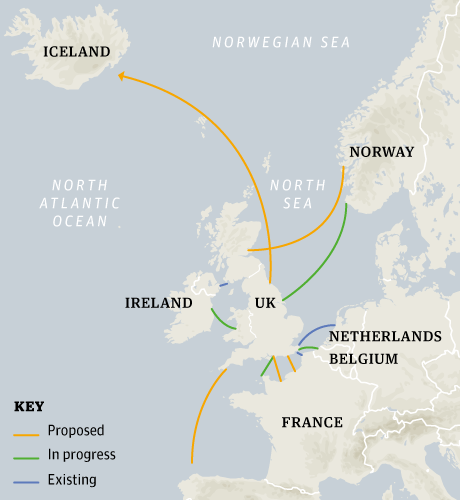
There are two existing international interconnectors, to France and the Netherlands, but nine more are either in construction, formal planning or undergoing feasibility studies. The next to open, in autumn 2012, will be a link between the Republic of Ireland and Wales, allowing green energy from the windswept Atlantic coast of Ireland to be delivered to British homes.
The UK has been energy independent for virtually its entire history. But with the North Sea's oil and gas failing and coal banned as too polluting, Hendry is frank about the future: "We will be dependent on imported energy." The cables "are an absolutely critical part of energy security and for low carbon energy", he said.
The government's legally binding targets to reduce carbon emissions is another key driver for the new interconnectors, which if all built could supply a third of the nation's average electricity demand. Renewable energy, such as the offshore wind power at the heart of the government's renewable plans, is zero carbon once built but is also intermittent, meaning back-up gas plants or energy storage are needed. A 900km interconnector to Norway, due to open by 2019, would enable excess wind energy to pump water into storage lakes above the fjords. Then, when the electricity is needed, floodgates are opened and the water flows back down through turbines. Both the pump storage and the high-voltage direct-current interconnectors lose very little energy.
Another ambitious interconnector would link England to Alderney, where very strong tides could produce 4GW of electricity, and then on to France and the new 1.6GW nuclear power plant being built at Flamanville. Commercial agreements for this were signed in February.
Interconnector cables can be laid very rapidly – at over 30km a day – but remain significant engineering projects, with each kilometre containing 800 tonnes of copper. The most time-consuming aspect is settling international agreements and preparing landing sites and pylons to handle and distribute a large amount of electricity. "It's like taking a large nuclear power station onshore," said Hendry.
He argued that a web of high-voltage cables ending the energy isolation of the British Isles will help keep household energy bills down, by allowing access to the cheapest energy at any particular time.
Tony Glover, at energy grid trade body the Energy Networks Association, said: "For consumers the ability to link electricity supplies from the rest of Europe is good for competition and will generally help to keep prices competitive." The interconnectors can be built commercially with operators paying for the investment by taking a cut on the electricity transferred.
As well as consumer energy bills, Hendry also argued that interconnectors will help reduce the cost of the intermittency of renewable energy. "Interconnectors are an incredibly effective way to counter the argument that you need to back up each gigawatt of wind with a gigawatt of gas – they quite clearly show you do not," he said.
Interconnectors require large investments. The Britain-Netherland interconnector, which opened in 2011 and was the first international link in 25 years, cost £500m. But Greenpeace's Doug Parr said: "Interconnectors are the cheapest way of backing up wind, because you avoid the greater capital cost of building power stations. We will of course be buying power in when the wind is not blowing, but the interconnectors mean we can sell our wind power when it does, and we have the best wind resource in Europe."
However, Simon Less at the thinktank Policy Exchange, urged caution in relying on interconnectors for back-up: "Major new interconnection in north western Europe might not offset much of the need for backup plant because winter high pressure weather patterns can extend low wind conditions right across Europe."
Norway's pump storage could counter that fear but there is competition for access to that resource, with Germany also negotiating over an interconnector. "We are keen we should be first," said Hendry.
http://www.guardian.co.uk/environment/2012/apr/11/iceland-volcano-green-power?newsfeed=true
#######################################################################################################################################
Two years ago, the eruption of the volcano Eyjafjallajökull caused havoc across Europe, with airborne ash grounding flights for six days.


The Eyjafjallajökull ash cloud. Photo by Páll Stefánsson.
Eyjafjallajökull may be quiet now, but, according to The Telegraph, activity has been increasing in the volcano belt that stretches diagonally across the middle of Iceland from the Westman Islands in the south to the Lake Mývatn area in the north, along the line of the American and Eurasian geological tectonic plates.


This region includes the volcano Katla, which has erupted about every 60 years (the last time in 1918), the volcano Hekla, which has erupted approximately once every ten years in the past decade (the last time in 2000), and Grímsvötn, which had a short eruption last year.


In the 17th and 19th centuries, eruptions of Eyjafjallajökull were followed within months by eruptions of Katla, and now too, Katla has been increasingly restless.
Increased activity has also been detected in the volcanoes under the largest ice cap, Vatnajökull, which is where Grímsvötn lies.

In July 2011, geothermal heat caused melting in Mýrdalsjökull, the ice cap covering Katla, producing a flood that destroyed an important bridge on the south coast of Iceland at the height of the tourist travel season.

According to precise GPS measurements, there has been movement of the surface of the volcano, as well as bursts of high earthquake activity beneath Katla's caldera, indicating that magma has risen closer to the surface.
Scientists have been monitoring the volcano closely ever since the glacial burst last July and every now and then earthquakes have caused concern that an eruption might be coming up. Yet while repeatedly making headlines last autumn, Katla has been rather quiet in recent months.
The scale of the damage from an eruption in Katla would depend on the direction of the wind, as well as on the style, size and duration of the eruption.
A major eruption of Katla could cause flooding, poisoning of agricultural land, destruction of property, interference with air traffic across Europe, and even global cooling for several years.
This is because Katla is likely to produce very fine ash, as did Eyjafjallajökull, which would remain airborne for days.
However, scientists stated in January that due to increased knowledge, better surveillance and more accurate forecast models—and the experience drawn from the eruptions in Eyjafjallajökull and Grímsvötn—future eruptions will cause fewer disturbances to air traffic than in 2010.
The University of Iceland is working with Delft University of Technology and other institutions to develop more accurate systems to track and predict volcanic activity, in order to deal with the threat and damage of eruption.
Last week the story broke that Askja volcano in the northeastern highland might be preparing to erupt as its crater lake, Öskjuvatn, was iceless despite frosty temperatures.

Travelers have been warned about visiting the area and scientists have launched a research expedition to determine the likelihood of an eruption.
Click here and here to read more about the situation at Askja.
##################################################################################################################################
US geologists to monitor Colombian volcano

A committee of American geologists will visit Colombia to assist with monitoring of the Nevado del Ruiz volcano, as it continues to show signs of activity.
According to the geological group Ingeominas, a team of Americans will be working at the Volcanic Observatory in Manizales to monitor the volcano, which was at a red alert level until Monday.
Continued seismic activity has forced volcanologists to maintain an orange alert as the volcano remained unstable and continued to emit gases.
The Nevado del Ruiz volcano last erupted in 1985, wiping out the town of Armero and killing 25,000 people. It is estimated up to 500,000 people could be at risk from a major eruption.
http://colombiareports.com/colombia-news/news/23335-us-geologists-to-monitor-colombian-volcano.html
Tungurahua volcano (Ecuador): moderately strong explosion on 11 April produces 4-5 km tall eruption column

The explosion ejected incandescent blocks to distances up to 500 to 600 meters below the crater rim on the northeast side. Seismically the explosion was followed by a signal of high-energy tremor that lasted about 40 minutes.
The explosion was heard in villages near the volcano and at the volcano Tungurahua Observatory (OVT), located 14 km north-west of the volcano.
From approximately 09:30 (local time) the energy and height of the eruption decreased significantly, and the height of the eruption column dropped to less than 1 km.
http://mobile.volcanodiscovery.com/tungurahua/news/7811/Tungurahua-volcano-explosion.html
--
Zenguins!
Vei8-Volcanoes of the World Webcams
Roxxfoxx~~Adventures in Geology
Penguin News Today
Penguinology: The Science of Penguins
Gentoo Penguins of Gars O'Higgins Station, Antarctica
Canis lupus 101
Dances with Werewolves
Through Golden Eyes

__._,_.___
No comments:
Post a Comment