Hi Coyote,
The entire thread is posted below, so you can catch up. :0)
The short answer is no that is not what I was saying. The movement of the rocks is still a mystery for the cause.
Allison mentioned ice movement, I explained why it (ice) can move (expansion forces during freezing giving way to the weakest point).
What I said was that wind effect is the weakest at ground level (interference from objects and the pressure on the ground creates a cushion of air, pilots call this 'ground effect'; that cushion is enough that a small plane can actually fly below stall speed but not by much, handy when taking off from really rough runways).
Considering the amount of energy needed to overcome the friction between the ground and the rock; more because the rock settles into the playa, it wouldn't seem likely that the winds would be strong enough to move the mass of the rock AND overcome the friction (and suction effect after the rock settles in if/when wet).
Unless my internal compass is wrong (happens, but rarely) the narrow valley runs mostly N/S, not always in alignment with the winds (except during frontal passages). If it was the wind causing the movement of the rocks, the rocks would all move in the same direction (even accounting that it is partly a bowl shaped canyon at the playa distorting the flow of the wind). The rocks move in ALL directions at the same time, as evidenced by the tracks themselves. Strike two for the wind theory.
My best guess is that the material (the soil itself for a gross term) that makes up this particular playa is 'fluid' enough (elastic to a point) that it gives under the weight of the rock but not enough to allow the rock to sink (think neutral buoyancy). That the playa is occasionally given enough moisture to create a shallow lake, one must consider that water is one of the causal elements as well (that 'flooding' isn't enough to erase or diminish the tracks). The rocks originate from the canyon wall, falling down the slope, into the playa, generally move away from that wall (again, not all in the same direction at the same time) towards the middle of the playa, then make radical turns, even reversing direction.
If I remember correctly (I was there last year), the depth of the tracks are not consistent with varying sizes of the rocks, they are mostly less than an inch or so in depth, small berm on the edges. This creates an anomaly, one would expect a heavier rock to leave a deeper track (more mass, more downward pressure). But that anomaly is what makes me think that the playa contents are one of the major factors, it gives only THIS much, then becomes firm enough to support the mass of the rock. Larger rocks have more surface area, so you'd have to consider the actual weight per square area.
I'd suspect that it would be noteworthy to measure the water content of the playa at various points (surface, down XX mm, down YY meters etc.) and carefully measure the movement of the rocks by GPS because the surface may shift some too (may as well track the winds) to see what if any correlations show up. Factor in everything you can think of (lunar orbit, temperature, magnetic variations, material making up the rocks, chemical reaction from playa and rock, earthquakes [dormant volcano twenty miles away], measure the 'flatness' of the playa, does it shift or stay flat, China Lake bombing range not too far south, military aircraft have been known to transit the area at low altitudes, whatever other possible influences there may be. It's not one thing that is working here, it's a confluence and some of the data is missing. It would be an expensive graduate or gov't project. Since there are more pressing questions out there, it may be some time before this one gets answered.
It the meantime, it is a nice place to visit and wonder. It's a fun mental exercise among the flora (minimal) and fauna (well hidden) where there isn't a large human contingent (it's almost BFE). We're running out of those places faster than most think. ;0) Those are the places I crave (not desolate, just not so many humans). To stand in wonder and awe of creation itself without the background noise of humanity... <<<<sigh>>>>
Rick, WA6NHC/7, currently at Zion NP Utah (yup, too crowded for me here in off season, but still awesome).
iPad = small keypad = typos = sorry ;-)
(Sorry, I'm not sure I've watched this thread closely enough to know the context of Rick's comment...)
Rick, are you suggesting that the distance the rocks move is substantially a result of the distance a surface ice sheet the rocks were in expanded?
If so, WOW. I've read all I could on this mystery, and very much enjoyed my visit to the Playa one winter, but I never saw that theory! Could you please cite a study that supports it?
Mostly, as Lin's link says, the "favored mover" is said to be wind, with the effect enhanced by the wind's force upon the surface area of the ice sheet. The idea that wind can move the rocks by pushing much on a surface ice sheet seems farfetched to me, so I'm excited to hear a better theory!
coyote
Ice moves because water expands as it turns into ice (something has to give since water also cannot compress); then the surface melts to break the cohesion to other surfaces when pressure is applied. The lightly melted surface becomes slick, greasing the treads so to speak.
Rick, WA6NHC
iPad = small keypad = typos = sorry ;-)
Ice moves. We have videos of ice moving. I dunno why. But it does and maybe it moves the rocks.???Allison
Been there, seen that. Death Valley is a favorite winter escape locale (stay in Beatty; cheaper with cell and wifi, BEST candy store EVER!!!).
Wind isn't the answer, the rocks move in all directions and make radical turns, sometimes near course reversal. The amount of wind energy required to move the rocks of many tens of pounds mass (regardless of surface tension) would be very substantial, likely near hurricane speeds. Considering they're on the ground (lower wind applied pressure) the short answer is not the wind.
The road in is 27 miles of dust, rock and washboard with Joshua trees, cactus and local denizens. It requires a high clearance vehicle (Subaru does fine, truck is better). Other drivers don't watch out for you, so expect to be stressed, dirty with a sore butt. Take spare shoes, don't walk on the playa if it's wet (often just below the crust is wet). You'll find new vehicle rattles too (really sucky road, one of the worst I've traveled, I hate washboard). One road in, jeep trails out, sometimes. Mind the weather (no cell, no nuttin there to garner help).
Bonus: the same (newly paved) lead in road in takes you past Ubehebe Crater (hee bee jee bee in my dialect, watch Lin giggle). That's worth a look too (nearly always windy).
Some folks think aliens; chess games or weird sense of humor. :-P
Who knows...
73,
Rick wa6nhc
Tiny iPhone 5 keypad, typos are inevitable
The Sliding Rocks of Racetrack Playa
One of the most interesting mysteries of Death Valley National Park is the sliding rocks at Racetrack Playa (a playa is a dry lake bed). These rocks can be found on the floor of the playa with long trails behind them. Somehow these rocks slide across the playa, cutting a furrow in the sediment as they move.
Some of these rocks weigh several hundred pounds. That makes the question: "How do they move?" a very challenging one.
The truth: No one knows for sure exactly how these rocks move - although a few people have come up with some pretty good explanations. The reason why their movement remains a mystery: No one has ever seen them in motion!
Let's learn how they are thought to move....
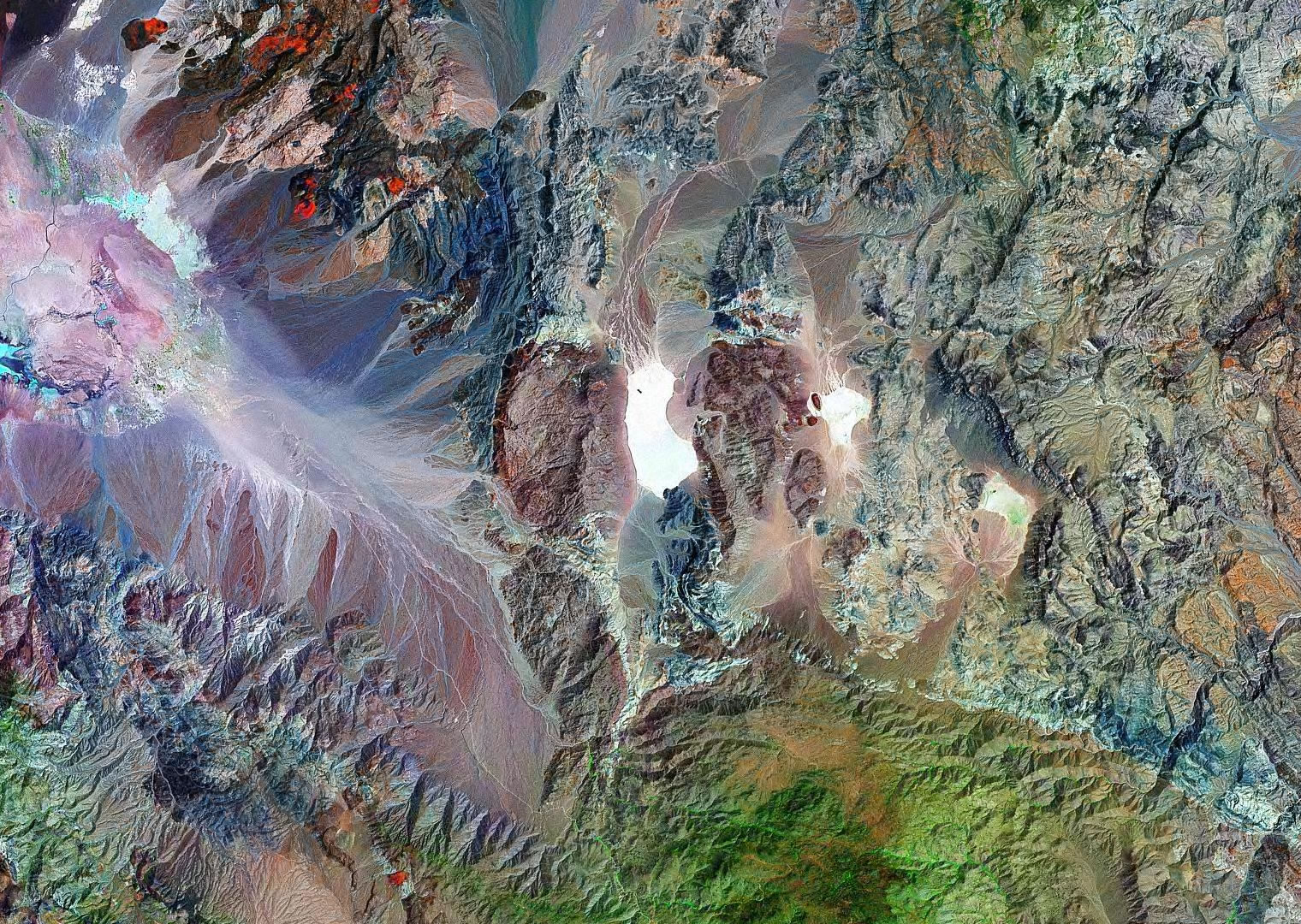
About Racetrack Playa Racetrack playa is lake bed that is almost perfectly flat and almost always dry. It is about 4 kilometers long (2.5 miles - north to south) and about 2 kilometers wide (1.25 miles - east to west). The surface is covered with mudcracks and the sediment is made up mainly of silt and clay.
The climate in this area is arid. It rains just a couple of inches per year. However, when it rains, the steep mountains which surround Racetrack Playa produce a large amount of runoff that converts the playa floor into a broad shallow lake. When wet, the surface of the playa is transformed into a very soft and very slippery mud.
Are They Moved by People or Animals? The shape of trails behind the rocks suggest that they move during times when the floor of Racetrack Playa is covered with a very soft mud. A lack of disturbed mud around the rock trails eliminates the possibility of a human or animal pushing or assisting the motion of the rocks.
Are They Moved by Wind? This is the favorite explanation. The prevailing winds that blow across Racetrack Playa travel from southwest to northeast. Most of the rock trails are parallel to this direction. This is strong evidence that wind is the prime mover or at least involved with the motion of the rocks.
Strong wind gusts are thought to nudge the rocks into motion. Once the rock begins to move a wind of much lower velocity can keep the rock in motion as it slides across the soft and very slippery mud. Curves in the rock trails are explained by shifts in wind direction or in how the wind interacts with an irregularly shaped rock.
Are They Moved by Ice? A few people have reported seeing Racetrack Playa covered by a thin layer of ice. One idea is that water freezes around the rocks and then wind, blowing across the top of the ice, drags the ice sheet with its embedded rocks across the surface of the playa.
Some researchers have found highly congruent trails on multiple rocks that strongly support this movement theory. However, the transport of a large ice sheet might be expected to mark the playa surface in other ways - these marks have not been found.
Other researchers experimented with stakes that would be disturbed by ice sheets. The rocks moved without disturbing the stakes. The evidence for ice-sheet transport is not consistent.
Wind is the Favored Mover! All of the best explanations involve wind as the energy source behind the movement of the rocks. The question remains is do they slide while encased in an ice sheet or do they simply side over the surface of the mud? Perhaps each of these methods is responsible for some rock movement?
Perhaps this story will remain more interesting if the real answer is never discovered!
NASA Studies on Sliding Rocks NASA sent a team of interns and mentors to Racetrack Playa during Summer 2010. They made observations, performed tests, compiled data and developed some ideas about how the rocks might move. Check out their report and photos.
Photos of Sliding Rocks Below! Movement of a large rock across a barren surface is almost impossible to believe. However, good photographs can serve as evidence for those who can not travel to Death Valley National Park. Thanks to Steve Geer, Stephan Hoerold, Skye Bajoul, sartriano, John Alcorn and Mike Nortan for the great images used here.
Contributor: Hobart King
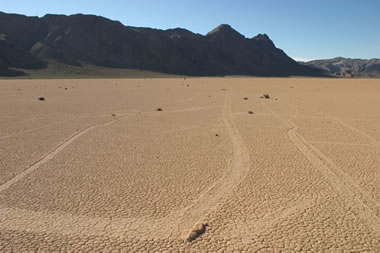
| Lots of sliding rocks and trails on Racetrack Playa © iStockphoto / Stephan Hoerold |

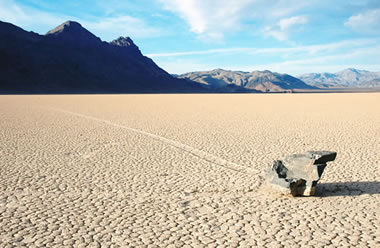
| Rocks of many shapes leave trails across Racetrack Playa. © iStockphoto / sartriano |
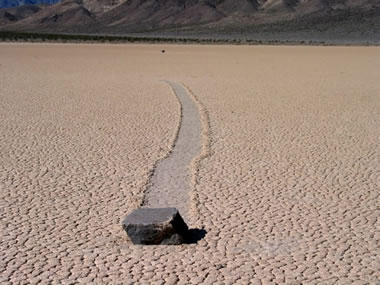
| Rocks of many shapes leave trails across Racetrack Playa. © iStockphoto / John Alcorn |
| | 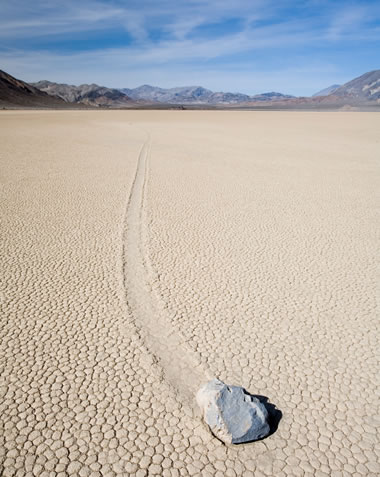
| A sliding rock that has left a long track across the surface of Racetrack Playa. Some tracks are hundreds of feet long! (See below for several more sliding rock photos.) © iStockphoto / Steve Geer. |
| One of the favored ideas for how the rocks move assumes that they occasionally are embedded in a thin sheet of ice. |
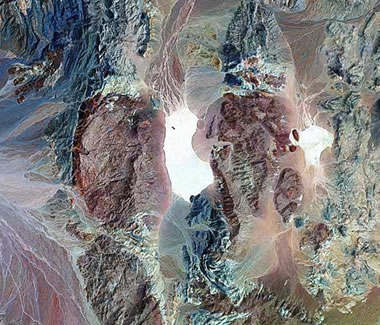
| Landsat image of Racetrack Playa. It is the flat white area in the center of the image.(click for more detail) |
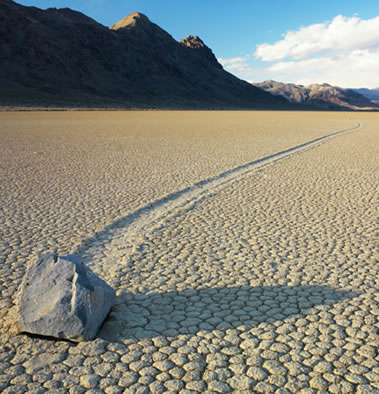
| Rocks of many sizes and shapes leave tracks across Racetrack Playa. © iStockphoto / David Choo. |
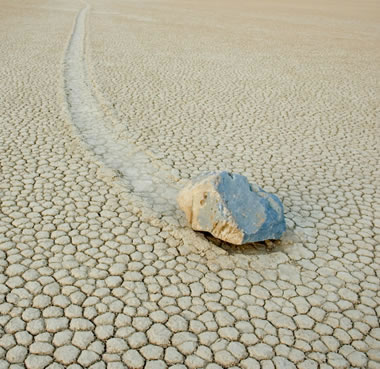
| Closer view of the sliding rock in the top image on this page. © iStockphoto / Skye Bajoul |

| This rock is one that is easy to imagine sliding across the top of a slippery mud-cracked surface. © iStockphoto / Mike Norton |
|
--



No comments:
Post a Comment