Geyser enthusiast studies Yellowstone National Park's remote eruptions
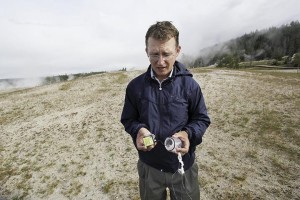
Jeff Cross, who has been traveling to Yellowstone Park for the past 24 years to study its geysers, shows off some equipment he uses to monitor geysers in the park's backcountry.
Posted: Monday, August 15, 2011
At just past 8 one recent morning, Jeff Cross strode toward Geyser Hill as his walkie-talkie blared: "Ten minutes!"
A fellow geyser enthusiast was counting down to the eruption of Yellowstone National Park's Beehive Geyser. Cross hurriedly walked across the boardwalks, through tourists and past colorful thermal features until he reached Beehive.
Within minutes it erupted, sending a powerful deluge of hot steaming water into the air.
It was just such a spectacle that piqued Cross's interest in geysers decades ago on his first trip to Yellowstone. Ever since, he's been doing all he can to learn more about the unique thermal features.
For the geyser enthusiast, Yellowstone National Park couldn't be a better classroom. It's the largest geyser field in the world and contains more than half of all the earth's geysers, which erupt from about an inch in height to more than 100 feet. Its rhyolite and volcanic activity make it a place where normally rare geysers become somewhat common.
Cross, now a chemistry professor at the University of Utah, returns to the park each summer to research backcountry geysers. He uses a special tool to monitor their eruptions, and also searches for new geysers. He said he's found several this year.
Cross, who's also an editor of Transactions, a Geyser Observation and Study Association publication, said he's seen so many geysers erupt that he's stopped counting.
But even after seeing all those geysers, there's still much to learn.
"They're always changing, always different every year," Cross said. "That's one fascinating thing about geysers."
Beehive Geyser, for example, has erupted at different intervals throughout its history. According to T. Scott Bryan's book, The Geysers of Yellowstone, it erupted daily between the early 1970s and into 2005. But then its eruptions started occurring between one day and a few weeks apart. In 2008, it again resumed more frequent activity.
Cross said the most regular geysers, like Old Faithful, must be isolated from other geysers. That's because nearby geysers tend to trade energy.
"When two geysers are related they can act together or in opposition," he said.
The Big Anenome and Little Anenome geysers, for example, can erupt at the same time, one before the other, or one and not the other.
Cross first started learning about geysers after that first trip to Yellowstone, when he and his father Carlton Cross, who taught electrical engineering, went home to try to build their own geyser models.
In their first attempts they used a canning jar - which exploded.
"People shouldn't use those," Cross now says.
Over time his models got more sophisticated, progressing from the canning jar to a pineapple juice can to a laboratory flask. Now he can efficiently set up a model and use it to understand more about the geysers he sees in the field.
When Cross does find geysers in the backcountry, he uses what's called a data logger to monitor the intervals between their eruptions when no one is there to see them. In 1998, he got his first research permit to use the tool, which includes a miniature computer that stores data and a thermometer.
Cross places the thermometer in a channel that flows with water, and fills more when a geyser erupts. He'll leave it there for a length of time and when he returns, he can see how often the temperature of the water in the channel has risen. Each time there's a higher temperature, it means there's been an eruption.
"Sometimes there would be no way of knowing how often a geyser erupted without the data logger," he said.
He's monitored a geyser that went off every five days, and another that went off just about every hour.
"When we arrived one day it was going off at 10 minutes after the hour," he said of the latter geyser. 'When we left three days later, it was going off 15 minutes after the hour."
Cross said it's the most regular geyser he's seen.
He also said he's discovered some new geysers in the backcountry. One newer geyser had burnt grass around it, which meant it hadn't erupted before because grass had been able to grow, Cross said. But he could tell it had erupted recently because the grass was burnt from the hot water.
Although Cross' fascination seems to have now turned to backcountry geysers, he still loves to see the geysers off boardwalks, particularly on Geyser Hill behind Old Faithful.
There, he recently walked over to see Aurum Geyser.
Cross is a member of the so-called "Geyser Gazers," a group of people who monitor eruptions to learn more about them. They take turns watching different geysers, and inform each other when one is about to go off. At Aurum, Cross ran into a fellow Geyser Gazer, Demetri Stoumbos.
Stoumbos had been waking up in the early hours of the morning to monitor geysers. Asked why he liked them, he answered: "The unpredictability."
That, too, seems to be what interests Cross the most.
"They're just so unlike anything you would expect to see anywhere else," he said.
Source--
Penguin News Today
Penguinology: The Science of Penguins
Gentoo Penguins of Gars O'Higgins Station, Antarctica
Canis lupus 101
Dances with Werewolve
Through Golden Eyes

__._,_.___

No comments:
Post a Comment