VIDEO: Pulsating lava lake covers surface of Kilauea volcano's Puu O'o crater
by: Derek Paivaposted: Fri Oct 08, 2010 at 06:03 PM

A 30-foot deep molten lava lake began forming on the floor of Kilauea volcano's Puu O'o crater this week, fed by the newest phase of activity from the longtime eruption.
USGS geologists at the Big Island's Hawaii Volcano Observatory captured the video on the bottom of this page on a Wednesday flyover of the crater. The video's first half shows lava actively pulsating and spattering on the surface of a small lava lake in the north floor of the crater. The final portion of the video, sped up with a wider view of the eruption site, shows how the spattering vent is feeding flows on the crater floor.
HVO geologists believe the vent opened at 6 a.m. Wednesday morning, creating a lava lake on the crater floor up to 33 feet deep by 10:30 a.m. the same day. HVO reported this morning that similar lava activity was continuing on the floor of the Puu O'o vent.
Want to see the lava lake firsthand? You'll have to be a bit resourceful.
Puu O'o is located in Hawaii Volcanoes National Park's remote east rift zone, where even the closest trails to the vent keep hikers a safe distance away. The best views of this eruption are from helicopter tours, which fly over Puu O'o and its surrounding lava fields stretching down to the Puna coastline.

Underground and surface flows from Kilauea's Puu O'o vent have been the main feeders of lava to the Puna coastline since the vent first burst to life on January 3, 1983. According to HVO scientists, Puu O'o has produced the largest volume of lava in Kilauea volcano's east rift zone in five centuries. The vent's 27 years of continuous eruptive activity and ocean-reaching flows have added more than 500-plus acres of land to the Big Island coastline.
Puu O'o last made worldwide headlines in July, when lava flows from the vent claimed a home in the Kalapana area. Between April 1990 and February 1991, the small town of Kalapana and its Kalapana Gardens residential subdivision had been largely destroyed by lava flows from Kupaianaha, a now inactive vent two miles northeast of Puu O'o.
Though Kilauea had sent flows to the coastline further south of Kalapana for much of Puu O'o's eruptive life, the last flow to enter the Puna district town happened in 1992. Lava from Puu O'o is still creating new land on the Puna coastline, fed by an underground tube system.
Kilauea volcano's summit Halemaumau crater vent has been producing a steam and ash plume from an expanding crack in its floor since March 2008. Halemaumau's occasionally explosive eruptive episodes are visible to Hawaii Volcanoes National Park visitors from the Hawaiian Volcano Observatory's Thomas A. Jaggar Museum overlook.
Click on the frame below for Hawaii Volcano Observatory video of the Puu O'o lava lake in action:

Source
------------------------------------------------------------------------------------------------------------------------------------------------------------
Volcano Watch: Kilauea's 1934 eruption interrupted years of quiet
Posted on 10:57 pm, Thursday, October 7, 2010.
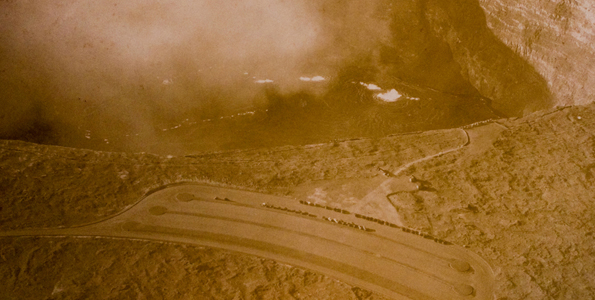
On Sept. 6, 1934, visitors flocked to the overlook on the southeast side of Halemaumau Crater as vigorous fountains erupted from the lake of lava covering the crater floor. (Photo courtesy of USGS)
(Volcano Watch is a weekly article written by scientists at the U.S. Geological Survey's Hawaiian Volcano Observatory.)
Seventy-six years ago this week — Oct. 8, 1934 — a 33-day-long eruption in Halemaumau Crater came to an end. This eruption began after almost three years of quiet at Kilauea Volcano.
The long period of inactivity from December 1931 to September 1934 was bad news for George Lycurgus, who had repurchased Volcano House in 1932, hoping to fill the 115 hotel rooms with guests eager to see an erupting volcano. With no volcanic activity to attract crowds of sightseers, "Uncle George" claimed he was practically bankrupt by late summer 1934.
With ongoing financial worries, Lycurgus took matters into his own hands on the night of Sept. 5, 1934. A stanch believer in Pele, he and Alec Lancaster, a local guide, trekked out to Halemaumau, where they invoked the volcano goddess with prayers and tossed an ohelo berry lei into the crater.
For good measure, Uncle George established his own ritual by also tossing in a bottle of gin — minus the swigs he and Lancaster had taken during their hike — and returned to Volcano House to get some sleep.
A few hours later, at 2:44 a.m. Sept. 6, lava erupted from the floor of Halemaumau — bringing thousands of spectators to the crater rim and patrons to Volcano House. Convinced that Pele had helped him in his time of need, Lycurgus held resolute faith in the volcano goddess for the rest of his life.
Indicators of the 1934 eruption, which included rock slides in Halemaumau Crater and southwesterly tilt of Kilauea's summit, were noted by the Hawaiian Volcano Observatory (HVO) on the afternoon of Sept. 5. Seismic instruments also recorded spasms of volcanic tremor about an hour before the eruption began.
Lava fountains initially erupted at three places within Halemaumau Crater. Cascades of incandescent lava surged from a 275-meter (900-foot) horizontal crack about half-way up the west wall of Halemaumau. Thirty jets of brilliant lava also shot up from the northwest crater floor, sending fragments of pumice (frothy lava) several hundred feet above the crater rim.
Lava flows spreading across the floor of Halemaumau coalesced to form a glowing lake that quickly submerged the third — and most northern — line of fountains. Within hours, the entire crater floor was covered by lava 18 m (60 ft) deep.
The vigorous lava fountains generated rumbling sounds that seemed to shake the whole volcano, while the rush of hot gas set in motion hundreds of whirlwinds that swept clouds of pumice and dust up onto the western rim of Halemaumau. In the first 12 hours of the eruption, gas fumes rose several thousand feet into the air, filling it with the odor of sulfur dioxide.
The west and northwest fountains ceased within about 12 hours, but the north fountains persisted at the lake's center. In a national radio broadcast from the rim of Halemaumau on Sept. 11, HVO geologist Thomas Jaggar described the lava lake as "indescribably beautiful, a vast labyrinth of glowing cobweb pattern ever changing radial and concentric to the central fountain group."
Repeated overflows built a levee around the lake, which eventually shrank in size, forming a small pond atop a terraced heap on the northeast side of the crater floor. Convective circulation developed within the lake, with lava welling up on the west side and draining back on the east.
The north fountains gradually dwindled, but lava continued to erupt beneath the cooling surface of the recently emplaced lava in Halemaumau. Consequently, molten lava oozed up in cracks between the crater walls and the crust that covered the crater floor.
As the eruption waned, the lava lake repeatedly drained and filled. Drainage episodes were accompanied by violent bursts of gas, which produced detonations that were heard up to three miles away. After half-an-hour of complete quiet, lava would then stream back in and restore the lake.
Interestingly, the end of the 1934 eruption on Oct. 8 marked the beginning of Kilauea's longest period of inactivity on record — 18 years! When the volcano finally erupted again in 1952, the 93-year-old Lycurgus was there to observe the action — mostly from the comfort of Volcano House, which he still managed — and to pay homage to Pele at the rim of Halemaumau Crater.
--
Got Penguins?
Penguin News Today
The Science of Penguins
Gentoo Penguins of Gars O'Higgins Station, Antarctica
>^,,^<
__._,_.___

No comments:
Post a Comment