Synopsis: Chance of El Niño increases during the remainder of the year, exceeding 65% during summer.
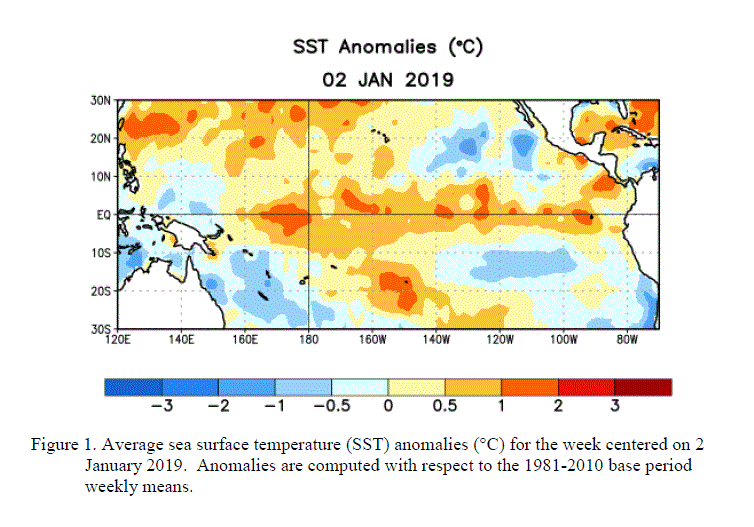
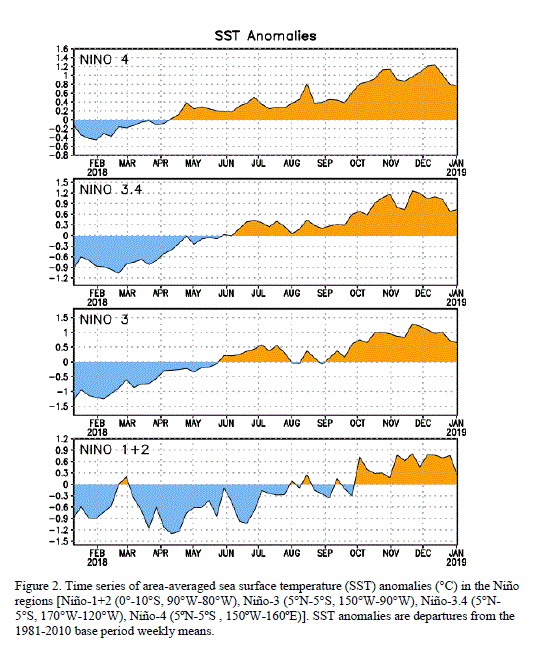
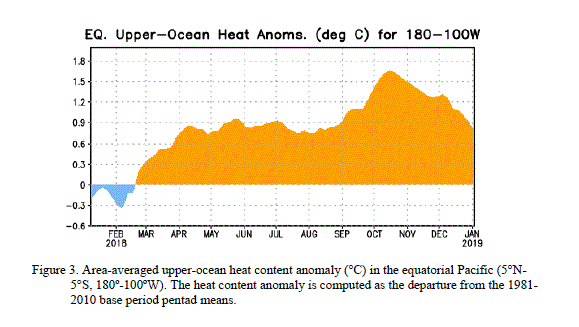
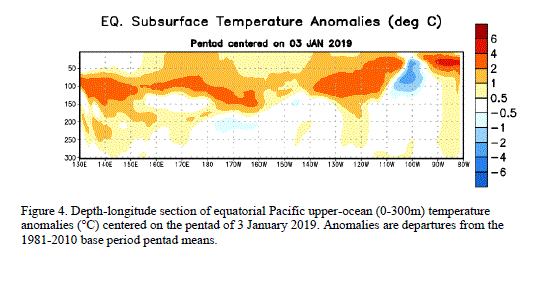
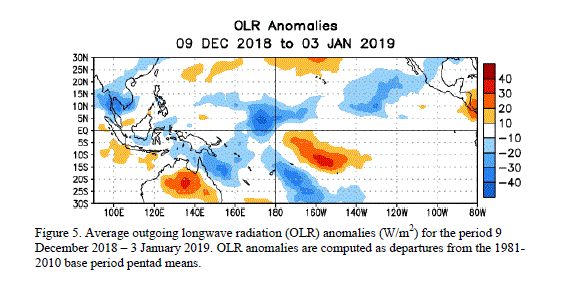
ENSO-neutral continued during April 2014, but with above-average sea surface temperatures (SST) developing over much of the eastern tropical Pacific as well as persisting near the International Date Line (Fig. 1). The weekly SST indices were near to slightly above average and increasing in the Niño1+2, Niño3 and Niño3.4 regions, and above average in the Niño4 region (Fig. 2). The downwelling phase of a strong oceanic Kelvin wave that began in January greatly increased the oceanic heat content during March and April (Fig. 3), and produced large positive subsurface temperature anomalies across the central and eastern Pacific (Fig. 4). The upper portion of these subsurface anomalies reached the sea surface, warming the waters east of 125oW longitude. Also during April, weak low-level westerly wind anomalies were observed over the far western Pacific, while upper-level easterly anomalies occurred over much of the Pacific. Convection was enhanced over the west-central equatorial Pacific (Fig. 5). These atmospheric and oceanic conditions collectively indicate a continued evolution toward El Niño.
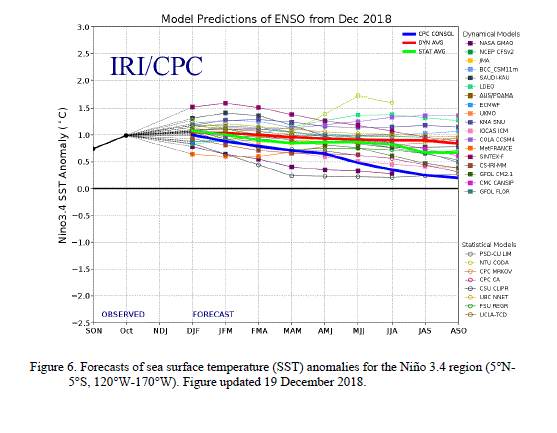
The model predictions of ENSO for this summer and beyond are indicating an increased likelihood of El Niño compared with those from last month. Most of the models indicate that ENSO-neutral (Niño-3.4 index between -0.5oC and 0.5oC) will persist through part of the remainder of the Northern Hemisphere spring 2014 (Fig. 6), most likely transitioning to El Niño during the summer. There remains uncertainty as to exactly when El Niño will develop and an even greater uncertainty as to how strong it may become. This uncertainty is related to the inherently lower forecast skill of the models for forecasts made in the spring. While ENSO-neutral is favored for Northern Hemisphere spring, the chance of El Niño increases during the remainder of the year, exceeding 65% during the summer (click CPC/IRI consensus forecast for the chance of each outcome).
Source: http://www.cpc.ncep.noaa.gov/products/analysis_monitoring/enso_advisory/ensodisc.html--
Read my blog at http://eclecticarcania.blogspot.com/
My Facebook: http://www.facebook.com/derkimster
Linkedin profile: http://www.linkedin.com/pub/kim-noyes/9/3a1/2b8
Follow me on Twitter @CalDisasters
__._,_.___


No comments:
Post a Comment