Piecing together April's deadly earthquake in Nepal
Resonance took down taller buildings; risk of another big one remains next door.
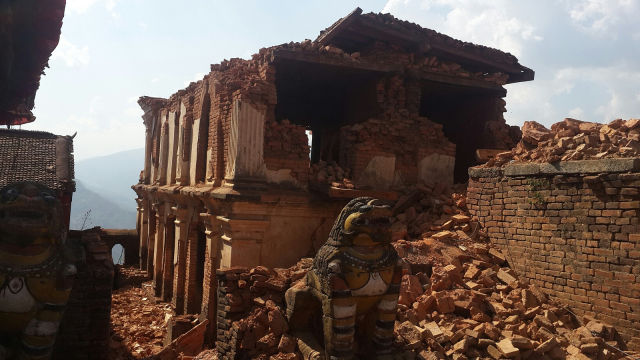
Seismic risks can loom over a region for long periods of time before striking. In April, longstanding fears about Kathmandu's susceptibility to earthquakes were realized when the shaking of a magnitude 7.8 Himalayan quake killed more than 8,000 people. A pair of new studies published this week piece together what happened along the fault that moved, and they tell us where the risk is highest for the next big earthquake in the area.
The mighty Himalayas have been driven up into the sky by the collision of Eurasia and India, which has migrated north like a tectonic rocket over the last 100 million years. The Indian plate is being crammed beneath the crumpled Himalayan rocks along a dangerous fault that ramps downward to the north.
Lots of GPS sensors and seismometers have been deployed in the area to help seismologists study earthquakes here. Combined with precise satellite measurements of surface elevation changes, researchers have the means to work out where the movement on the fault must have occurred.
The earthquake began about 80 kilometers northwest of Kathmandu and about 15 kilometers beneath the surface. Geologists like to talk about faults "unzipping," which is a helpful way to visualize what's going on. A small patch of the fault plane slips, and then expands outward along the fault. In this case, the patch unzipped about 140 kilometers to the east in under a minute, traveling horizontally along the fault plane. Within that patch, the rocks slipped as much as six meters past each other.
Although it's the seismic energy released by that sudden motion that causes the damage, the surface changes are still eye-catching—some of the GPS stations ended up two meters south of where they had been before the earthquake.
As for that seismic shaking, the pattern of building damage in Kathmandu was partly the result of the geology beneath the city. It sits on a roughly 500-meter-thick stack of lake and river sediment filling a bedrock bowl. The reverberation of seismic waves in that bowl produced a resonance, building stronger waves with a period of 4 to 5 seconds. While fewer homes were actually damaged than expected, taller buildings—which can sway at about that same frequency—didn't fare as well. (A similar thing happened in the 1985 Mexico City earthquake, when buildings between 6 and 15 stories bore the brunt.)
The quake occurred on a portion of the fault that has seen a fair number of tiny earthquakes in recent years, but it also hosted a magnitude 7.6 or 7.7 earthquake just 182 years ago. Just east of this area, a monster 8.2 quake hit in 1934. Given that past earthquakes have been separated by longer intervals than that, the researchers think the risk of another big one in the near future is low for this section.

Magnitude 8.2 earthquake off Chile increased risk nearby
Rather than relieving stress, it shifted it to neighboring fault segments.
Just to the west of April's earthquake, however, there hasn't been a huge earthquake since 1505—and that one weighed in around magnitude 8.5, nearly 22 times as energetic as April's quake. That makes this area a "seismic gap" where built-up strain hasn't been relieved in a long time. (In other words, "It's quiet… Too quiet.") If it did rupture, the fault could slide 10 meters or more. The authors of one of the papers say that this section of the fault "calls for special attention," as it's likely the next seismic risk looming over the region.
Nature Geoscience, 2015. DOI: 10.1038/NGEO2518, Open Access at Science, 2015. DOI: 10.1126/science.aac6383 (About DOIs).
______________________________________________________________________________
Warning for Nepal: April Earthquake Didn't Unleash All Its Energy
 |
 Satellite radar image of the ground changes due to the magnitude-7.8 Nepal earthquake on April 25. Satellite radar image of the ground changes due to the magnitude-7.8 Nepal earthquake on April 25.Credit: ESA SEOM InSARap Study – Norut/PPO.labs/Univ Leeds |
The devastating earthquake that struck Nepal in April released only a fraction of the energy still trapped in the underlying fault, meaning the area has the potential to host another large earthquake in the future, researchers say.
In April, a magnitude-7.8 earthquake struck 50 miles (80 kilometers) northwest of Nepal's capital of Kathmandu, killing more than 9,000 people and flattening entire villages. Geologists thought this quake originated on the Main Himalayan Thrust.
"The Main Himalayan Thrust is a fault that has produced large earthquakes every century or so," said study lead author Jean-Philippe Avouac, a geophysicist at the University of Cambridge in England. "Nepal lost two kings to these quakes, one in 1255, another in 1344. The last large earthquake to hit Nepal, a magnitude-8.2 earthquake in 1934, destroyed Kathmandu, as did a magnitude-7.6 earthquake in 183." [Nepal Earthquake Photos: Odd Effects of Kathmandu Temblor]
Scientists think major earthquakes happen at faults or cracks in the earth when rocks that are locked in place slip, releasing accumulated stress in a catastrophic manner. To investigate how much energy of the Main Himalayan Thrust had been unlocked during the April quake — and how much had not, holding the potential to burst with a major earthquake in the future — seismologists analyzed the effects of the disaster using seismometers on the ground and radar images taken by satellites in space.
The researchers found the quake spread eastward at speeds of about 6,700 mph (10,800 km/h), traveling a distance of about 87 miles (140 km), "unzipping the lower edge of the locked portion of the Main Himalayan Thrust fault over which the Himalayas were built," said Avouac, who, along with colleagues, detailed the findings online today (Aug. 6) in the journal Nature Geoscience.
This earthquake "was actually relatively small," Avouac said. "Although it was certainly a tragedy, with close to 10,000 people killed, it's not in the family of the very large earthquakes this area can see."
Indeed, the April quake unlocked only a small fraction of the fault. "A strip of the fault about 120 kilometers wide (75 miles) is fully locked from one end of the Himalaya to the other over a distance of 2,000 kilometers (1,240 miles)," Avouac said.
This long, fully locked western part of the fault "has not ripped since 1505," he added, and he expects that it could release a much more powerful quake than the April temblor. "At some point there will be an earthquake there, and it will be quite scary — there is more energy to release, since energy has built up there since the last earthquake."
Avouac suggested it was pure chance that the April earthquake traveled eastward instead of westward. "If the earthquake had propagated westward instead of eastward, it could have really been a disastrous earthquake, because there are a lot of people living there in front of the Himalayas now," he said. "That didn't used to be true — before the '50s and '60s, few people lived there, since it was mostly jungle, and there was a lot of malaria. But now the jungle has been cleared."
In another study, Avouac and his colleagues used GPS networks in the area of the earthquake to monitor how exactly the fault ruptured. They found the fault slipped over a relatively short span of six seconds, speeding up and slowing down rather smoothly. As a result, it did not generate the kind of high-frequency seismic waves that often destroy the shorter buildings that people often reside in, the findings detailed in the Aug. 7 issue of the journal Science. [See Photos of This Millennium's Destructive Earthquakes]
"When I heard there was a magnitude-7.8 quake so close to Kathmandu, I got really scared — I was prepared for a death toll of over 300,000, maybe 400,000, people," Avouac said. "For reference, the 2005 earthquake in Kashmir was in a less-populated area, and was only a magnitude 7.6, and it killed 85,000 people. But this quake in Nepal didn't kill that many people because it didn't generate a lot of high-frequency seismic waves."

 Mount Everest before (April 14) and after (April 23) the Nepal earthquake. The April 23 image was acquired by the Operational Land Imager on Landsat 8; and the April 28 image was acquired by the Advanced Land Imager on Earth Observing-1.
Credit: NASA
These data might shed light on megathrust earthquakes like the April quake in Nepal, which happen when two tectonic plates converge and one plate is forced underneath the other. "It may be that an intrinsic property of megathrust earthquakes is that there might not be a lot of high-frequency seismic waves at the edges of the rupture zones, which is some good news," Avouac said.
Still, the April quake did reduce many tall structures to rubble, such as the nine-story Dharahara Tower, once the tallest building in Nepal, a landmark built by Nepal's monarchs as a watchtower. This is because the earthquake generated lower-frequency seismic waves that resonated off the basin of rock under Kathmandu, setting up vibrations that toppled tall structures while leaving smaller buildings unharmed, Avouac said.
The researchers cannot say when the next large earthquake will happen in that area. "It might take another decade; it might take several decades," Avouac said. "But it's important that people living in those areas be aware that there's a serious risk of large earthquakes there, and prepare to build buildings better."
http://www.livescience.com/51772-nepal-earthquake-warning.html
--

__._,_.___


No comments:
Post a Comment