In mid-Missouri, we are used to tornadoes, floods and blizzards… but what about earthquakes?
Between December 1811 and February 1812, southeastern Missouri and northeastern Arkansas in the New Madrid Seismic Zone experienced four major earthquakes. This series of earthquakes each measured over 7.0. The largest was 7.5 and all were felt across the eastern half of the country.
University of Missouri seismologist Dr. Eric Sandvol says a strong earthquake in mid-Missouri is unlikely, but another strong one in southeast Missouri like the ones in 1811 and 1812 are possible and we would feel it here in mid-Missouri.
"If that happened... if we had a repeat of the events that happened over 200 years ago, we would certainly feel the impacts here. In fact, the Oklahoma City earthquake [in 2011] which was a magnitude 5.6 was felt here. The real question is how strongly would we feel it? Would there be damage?
Dr. Sandvol goes on to say there would be damage in mid-Missouri, but it would not be devastating.
"I don't think you would see catastrophic damage, what I think you would see is some damage to buildings… cracks in foundations. Probably a real worry would be about bridges... bridges that are spanning the Missouri river."
We asked Dr. Sandvol if mid-Missouri is due for another earthquake, and he told us there are many different views to that question.
"New Madrid is a very controversial seismic zone. There is a lot of disagreement. There are litigate seismologist and scientist who hold both views and my view is I don't think that we know. I think it is difficult when we don't even understand the physics and the origins of these interpolate earthquakes. it is difficult to judge if we are really overdue or this process has worked its way out and finished."
Dr. Sandvol says we are unable and may never be able to fully forecast earthquakes. The best scientists can do now is give a "percent probability" of one occurring over the next 50 years.
There is a lot of different documentation and reports from the earthquakes back in the early 1800s. Everything from cities being destroyed to the Mississippi River running backwards for a few hours was reported. There are not many pictures from the damage two centuries ago, but there are many archived newspaper and journal articles that tell of all of the damage that was caused by the four different earthquakes.
More information on the 1811 and 1812 earthquakes can be found at the links below:
http://earthquake.usgs.gov/earthquakes/states/events/1811-1812.php
http://www.new-madrid.mo.us/index.aspx?nid=132
Video available at source:
Here's a short trip around the area...


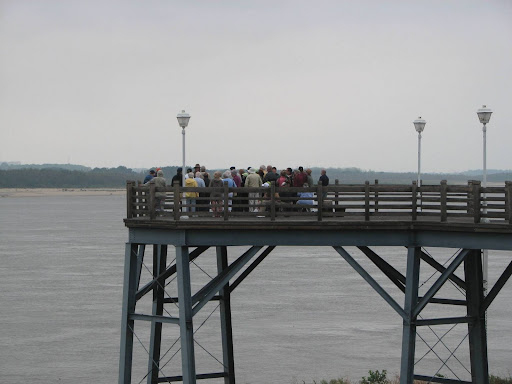
The location on the river of New Madrid. As you can see, the river is busy creating an oxbow lake.


This is the base of the Cypress Tree. Actually, this one is rather larger; most are about half this size.

The American Bald Eagle uses the Reelfoot area for nesting grounds in the winter.
--

__._,_.___


No comments:
Post a Comment