Cryoseisms (or frost quakes) in Maine
A cryoseism, or frost quake, is a natural phenomenon that produces ground shaking and noises similar to an earthquake, but is caused by sudden deep freezing of the ground. They typically occur in the first cold snap of the year when temperatures drop from above freezing to below zero, particularly if there is no snow cover to insulate the ground. The primary way that they are recognized is that, in contrast to an earthquake, the effects of a cryoseism are very localized. In some cases, people in houses a few hundred yards away do not notice anything. The reason that the vibrations do not travel very far is that cryoseisms don't release much energy compared with a true earthquake caused by dislocation of rock within the earth. On the other hand, since cryoseisms occur at the ground surface they can cause significant effects right at the site, enough to jar people awake. Cryoseisms typically occur between midnight and dawn, during the coldest part of the night. If conditions are right, they may occur in a series of booms and shakes over a few hours or even on successive nights.
There have been a few cases reported in the northeastern U.S. where people have been able to find a small crack in the ground where the cryoseism occurred. In these particular cases, it appears that the cracks are caused by the ground having contracted rapidly due to the sudden cold, and split apart - a literal "cold snap"! Unfortunately, that sort of evidence can be difficult to find because the cracks are quite small, they might be some distance away from where it was felt, and are liable to be covered by snow and healed by the spring thaw before anybody would notice them.
Due to their haphazard occurrence and the generally minor effects, there is not much scientific data about cryoseisms, but it seems that the particular combination of weather conditions is more important than the type of geology or soils in determining where they occur. Cryoseisms have been reported from upstate New York, Vermont, Massachusetts, Connecticut, and Maine.
List of recent Maine events that might have been cryoseisms.
Reference:
Lacroix, Andrew V., 1980, A short note on cryoseisms. Earthquake Notes, vol. 51, no. 1, pp. 15-20.
SourceVIDEO: Hawaii volcano upper rift zone rumbles, lava field report
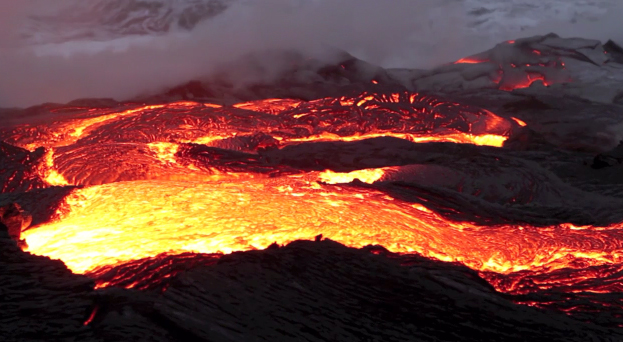 By Tim Bryan, field report courtesy Liegh Hilbert
Big Island Video News is keeping an eye on the USGS reports detailing the ongoing seismicity within the upper east rift zone that geologists say "continues to be a concern".
The language has appeared in consecutive daily eruption updates published by the Hawaiian Volcano Observatory. Of the twenty-three earthquakes that were strong enough to be located within Kilauea volcano – eighteen were located within the upper east rift zone.
This includes a 3.8 magnitude jolt that rocked the Volcano area around 8:30 a.m. on Thursday morning. The quake was centered 3 miles southeast of the active Kilauea summit. It was felt in numerous Volcano area subdivisions.
Less than 24 hours earlier, a 3.2 magnitude temblor shook the region… this time only 2 miles south of the summit.
Geologists have not ventured a guess as to what the increased seismicity could portend, nor do the scientists correlate the quakes to any specific volcanic activity, like the lava lake that continually rises and falls at the Halemaumau crater.
In today's report, published after this video was produced, HVO reports:
Forty-two earthquakes were strong enough to be located within Kilauea volcano – thirty-six were located within the upper east rift zone (most occurred between 8 and 11 am, were located between Puhimau and Pauahi Craters, and included a magnitude-3.8 quake at 8:30 am yesterday), four on south flank faults, and two immediately south and southwest of the summit caldera; measurements made yesterday on monitored cracks in the epicentral area showed no unusual movement; the ongoing seismicity within the upper east rift zone continues to be a concern.
For whats been going on further down the rift, we go to Liegh Hilbert, who files this field report at the ever changing Kalapana lava flow.
Video available here at SourceNew volcano images by USGS, earthquakes "a concern"
 By Tim Bryan, images courtesy USGS
A new spattering vent has formed on the south side of the Thanksgiving Eve Breakout shield, and the Hawaiian Volcano Observatory caught a glimpse of the activity just before daybreak on February 4.
The active Pu'u O'o crater floor is slowly filling the east side of the vent with lava.
Meanwhile, at Kilauea's summit, the circulating lava lake in the collapse pit deep within the floor of Halema`uma`u Crater has been visible via Webcam throughout the past week. Volcanic gas emissions remain elevated, resulting in high concentrations of sulfur dioxide downwind.
After this video was put together, the USGS gave this report on recent temblors in the region surrounding Kilauea. This statement was a part of Wednesday's Kilauea Status Report, issued at 8:30 a.m. The report serves as a summary of the activity at the volcano over the last 24 hours.
"Nineteen earthquakes were strong enough to be located within Kilauea volcano" stated the update, prepared by HVO scientists, "sixteen within the upper east rift zone (starting beneath Puhimau Crater and migrating both uprift to Keanakako`i Crater and downrift to Hi`iaka Crater) and three scattered beneath a broad area extending both north and south of the upper east rift zone nearer Makaopuhi and Napau Craters; the ongoing seismicity within the upper east rift zone continues to be a concern."
Visit the HVO Web site (http://hvo.wr.usgs.gov) for detailed Kilauea and Mauna Loa activity updates, recent volcano photos, recent earthquakes, and more; call (808) 967-8862 for a Kilauea summary; email questions to askHVO@usgs.gov.
Video available here at SourceLaser Photos Reveal Hidden Volcano, Pits of Mystery

Canby farm field. Aerial photo courtesy DOGAMI.
I have to admit I was thoroughly underwhelmed when geologist Ian Madin sent us to Haines Road near Canby. He said he'd found a previously undetected volcano. A perfect cone sat in a farmer's field. When we got there, all we found was rolling "hills" in a Christmas tree farm. Just not impressive.

Hidden Volcano near Canby
But Ian's photo showed something far more intriguing. He's the Chief Scientist at Oregon's Department of Geology and Mineral Industries and he's spending a lot of time with the most sophisticated imaging available. LIDAR uses lasers to map the land in stunning detail.
Using LIDAR, geologists can digitally remove every tree, bush and building to see the exact shape of the land underneath. A regular aerial photo shows just a farm field. LIDAR reveals a hidden volcano.

Pits of Mystery near Corvallis. LIDAR Courtesy DOGAMI.
Every more peculiar, Madin has spotted dozens of strange circles. Not crop circles. These are soil circles. The jury is still out what's leaving these large circular depressions throughout the Willamette Valley. (But they're never found in Washington County in the Tualatin basin. Odd.)
Just as before, we showed up in person and found a field with hollows that surely fill with water in the rainy season. They're nothing to write home about until you realize there are nearly two dozen on this one farm and they're all circular. Watch our story on Oregon Field Guide, Thursday, Feb. 10.
Videos available here at Source--
Got Penguins?
Penguin News Today
The Science of Penguins
The Gentoos are back! Come see them on live cam at:
Gentoo Penguins of Gars O'Higgins Station, Antarctica
__._,_.___

No comments:
Post a Comment